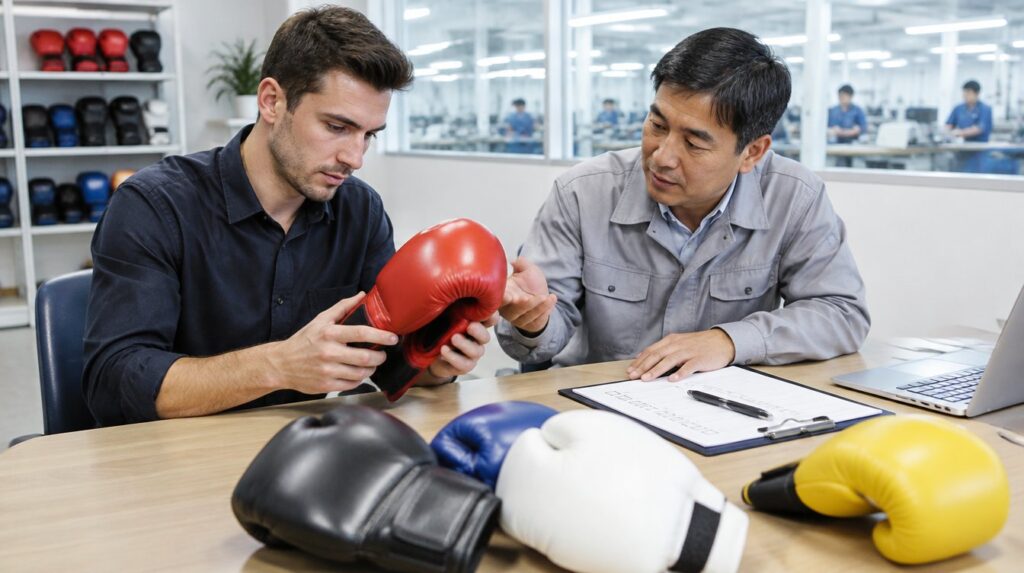
Choosing a boxing gloves manufacturer is one of the biggest decisions a combat sports brand makes. The factory you pick decides your product quality, your lead times and, in the end, your reputation with athletes. This checklist covers the eight things worth verifying before you place a first order.
1. Ask what the factory actually specialises in
Some suppliers are trading companies that outsource production, while others make everything in-house. Ask which stages (pattern cutting, stitching, padding, finishing, packing) happen under one roof. A manufacturer that controls these steps can answer technical questions quickly and fix problems faster.
2. Check the materials on offer
Boxing gloves are typically made from real leather, PU synthetic or PVC synthetic. Each has a different feel, durability and price point. Real leather suits premium and competition lines, while PU and PVC are common for training and entry-level ranges. A good partner will explain the trade-offs rather than push one option. See our boxing equipment manufacturing page for the materials we work with.
3. Look at weight and size options
Training, sparring and fight gloves are sold in different weights, and amateur and professional rules can differ. Confirm that the manufacturer can produce the weight range your market needs, and ask whether custom sizes are possible.
4. Understand the sampling process
Never skip samples. A clear sampling process (tech pack review, sample production, your feedback, approval) protects you from expensive surprises in bulk production. Ask how long samples usually take and how many revision rounds are normal.
5. Ask about quality control
Look for inspection at more than one stage, not only a final check. Multistage quality control catches stitching, padding and finishing issues before they reach the carton. Ask whether you can request an inspection report or arrange a third-party check.
6. Confirm customization and private label
Most brands want their own logo, colours and packaging. Check whether the factory handles custom logos, special colours, labels and branded packaging, and whether it works under OEM and private label arrangements so the glove carries your brand only.
7. Discuss MOQs and scalability
Minimum order quantities vary by factory and by design. A flexible manufacturer can support a small first run and scale as your sales grow. Ask for the MOQ per style and per colour, not just a headline number.
8. Verify export readiness
Exporting involves packaging standards, documentation and reliable shipping partners. Ask which markets the factory already ships to and how orders are packed for transit.
Questions to put in your first message
The quality of a manufacturer shows in how it answers specific questions. Instead of asking for a price per pair, send a short brief: the glove type (training, sparring or competition), the weight range, the outer material, the closure, your target market and the quantity you are considering. Then ask what the sample process looks like, how many revisions are included, and how the factory checks quality before shipping. Clear, specific answers are a good sign. Vague replies or a price with no questions back usually mean the supplier has not thought about your project.
Red flags to watch for
- No willingness to share photos or videos of the production floor.
- Prices far below every other quote, which often means cheaper padding or thinner materials.
- No sample step, or a sample that differs from the bulk order.
- Unclear answers about who owns your designs and moulds.
- Pressure to pay everything up front.
Planning a realistic timeline
Allow time for the whole process, not just production: briefing, sampling, approval, bulk manufacturing, packing and shipping. At Sedate Group, production averages 45 days after sample approval, so a new brand should plan its launch date around that and add time for freight. Starting the sample early is the easiest way to protect your launch.
About Sedate Group
Sedate Group of Industries has manufactured combat sports equipment and performance apparel in Sialkot, Pakistan since 2002. Today the company has a skilled workforce of 200+ people and 100+ advanced production machines, and our average production lead time is 45 days. Quotes are usually returned within 24 to 48 hours.
Next step
If you are comparing suppliers, send us your specification and target market and we will respond with a tailored plan. You can request a quote here, or read more about our manufacturing process.